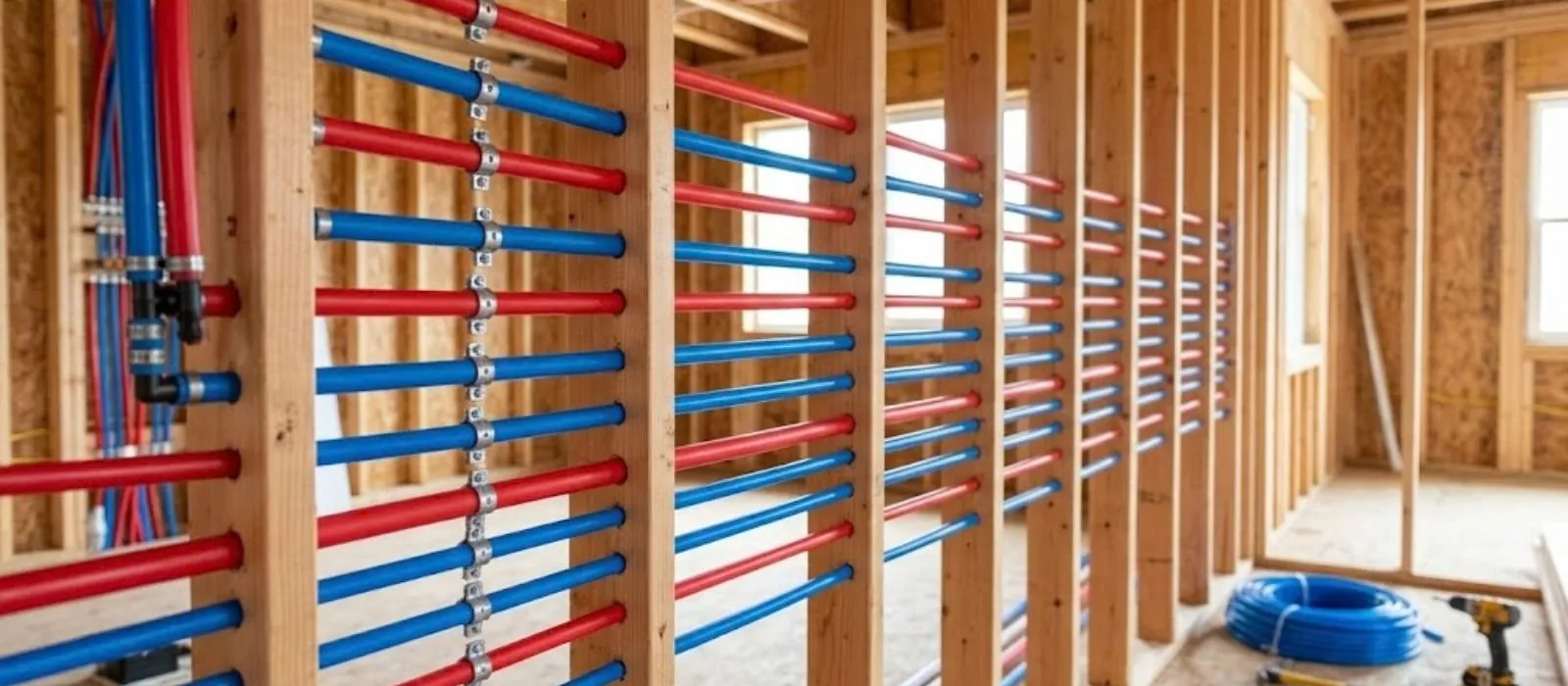
Low pressure, rusty water and pinhole leaks point to the pipes
Repiping means replacing the water supply lines inside a house with new pipe, usually from the main shutoff to every fixture. It is a different job from patching one leak. When the pipe itself is failing along its length, repairs stop holding and a repipe starts to make sense.
Low pressure at every tap
If every faucet and shower runs weak, and the outdoor hose bib is weak too, the pipe bore may be narrowed by corrosion and mineral build-up. Rule out cheaper causes first: a half-closed shutoff, a failing pressure regulator, a clogged aerator. A technician can read static pressure with a gauge on a hose bib.
Brown or rusty water
Rust at both hot and cold taps, worst after the house sits unused, usually means iron pipe is shedding inside. Rust in hot water only may come from the water heater tank. Run the cold tap first, and if it runs clear, check the heater before blaming the pipes.
Pinhole leaks and damp spots
A pinhole leak throws a thin jet inside a wall and may stain drywall before you see water. One pinhole is a repair. A second in another room points to the whole run wearing out. A leak under the floor is covered on our slab leak repair page, and a damp wall you cannot trace starts with leak detection.
Pipe materials for a repipe and what the Florida code lists
Table 605.4 of the 2023 Florida Building Code, Plumbing, lists the pipe allowed for water distribution inside a house. Listed pipe must meet NSF 61 and carry a pressure rating of at least 100 psi at 180 degrees F.
| Material | On the code list | What to weigh |
|---|---|---|
| Copper, types K, L and M | Yes | Long track record with soldered joints. It takes more labor to run through walls, and a leak means cutting out a section. |
| PEX, including PEX-AL-PEX | Yes | Flexible tubing with fewer joints, often run from a central manifold. Keep it out of sunlight, and use listed fittings. |
| CPVC | Yes | Rigid plastic. Older runs in hot attics can turn brittle and crack at fittings, which is why some owners replace them before a failure. |
| Galvanized steel | Yes, still listed | It rusts from inside and narrows over time, the usual reason a house gets repiped. |
| PVC, the white drain pipe | No, not for hot and cold inside the house | The code lists PVC for underground service pipe from the main, not for distribution in the house. |
| Polybutylene | Not on the list | It is not an approved material for new supply piping. |
Fittings must be approved for the pipe they join. Choose the material after a technician sees your attic, walls and existing run, not from a chart, and see plumbing installation for new fixtures that connect to it.
Not sure if it is a repair or a repipe?
Call with the year your home was built and what you see at the water heater, and we will say what a visit would look at.
Repair one section or repipe the whole house
Repiping costs more than a repair, so it should be earned by the evidence. These rules of thumb separate the two.
Repair a section when
- One leak traces to a fitting, valve or joint, not the pipe wall
- The pipe is copper and a sleeve or coupling can bridge a damaged spot
- Water runs clear and pressure is good at every other fixture
- The rest of the line looks clean where it was opened
Repipe when
- Pinholes keep appearing in different rooms
- Brown water shows at several fixtures and clears slowly
- Pressure is poor everywhere and the pressure check points to narrowed pipe
- Old CPVC is cracking at fittings
- A leak under the slab makes rerouting through the attic a sound alternative
If only the hot side is failing, only the hot lines can be replaced. Ask the technician what the pipe looks like where the leak was cut open, because that is the best evidence you will get.
A repipe, day by day
The number of days depends on house size, access and when the city inspector can come. This is the usual order, with the mess described honestly.
Day one: plan, permit and shutoff
The technician walks the house, picks the routes through attic, closets and walls, and confirms the material. The permit is pulled. Water goes off in stretches, so plan for showers and cooking elsewhere, and ask how water is restored each evening.
Next days: new lines go in
New pipe runs to each fixture, usually from the attic down. Small openings are cut in drywall at tubs, sinks and toilets. In a slab home, lines can run overhead instead of under the floor.
Connections, pressure test and inspection
Fixtures are connected to the new lines, the system is filled and tested for leaks, and the city inspection follows.
Patching
The drywall holes are patched. Paint matching and texture are often a separate trade, so ask what is included. Expect visible patches until painting is done.
What a repipe costs depends on these things
Two repipes on the same street can differ a lot. These are the factors that set the price.
Homeowners policies typically respond to sudden and accidental water damage, and not to wear, gradual leaks or the pipe itself. A repipe done because pipe is aging is usually your cost. Ask your insurer before the work.
Ocoee homes by age, and the pipe behind your walls
City records cannot tell us what is in your walls. Here is what they do say, and what we do about the gap.
Most homes are not very old
A city housing element built on census data says almost all Ocoee homes standing in 2000 were built after 1960, almost 88 percent after 1970, and almost half between 1990 and 2000. The data stops at 2000 and misses later growth. Few Ocoee homes carry century-old pipe, but pipe from the 1960s to the 1990s can still be failing, so the year built is the first question.
Older streets near downtown
The Town of Ocoee was platted in 1886, and the city says downtown grew from that land. An old house often holds several generations of repairs in several metals. Have a technician identify what is behind each wall before you choose a repair or a repipe.
The city's service line is not your pipe
Ocoee's 2025 water report says an initial 2024 inventory found no lead or galvanized service lines requiring replacement. The city's responsibility ends at the meter, so the pipe inside your house is yours, and its material is a separate question.
Tell us the year and the pipe
When you call, give the year your home was built and what pipe you can see at the water heater and under the sinks. We ask what pipe is behind the walls, and a technician confirms it on site before any repipe is quoted.
We also repipe homes in Windermere and take same-day appointments there when available.
Permit: ask the Ocoee Building Division before work starts
Ocoee's residential plumbing fee sheet lists a re-pipe permit category of its own, apart from ordinary plumbing repairs, and the city names plumbing among work that needs a permit. Apply at permits.ocoee.org or at the Building Division in City Hall, 1 N. Bluford Avenue, phone 407-905-3104.
The city requires contractors to show active registration, proof of a state license and insurance. You can check any plumber's license on the Florida Department of Business and Professional Regulation lookup, by name or license number. If a quote leaves the permit to you, ask why.
Repiping questions from Ocoee homeowners
No. The code's list for distribution pipe inside a house omits PVC. CPVC, PEX and copper are on it. White PVC is for drains and for underground service pipe.
A plumber will pick among the listed materials after seeing your attic and walls.
Not by itself. Check whether it is one fixture or all of them. One weak tap is usually an aerator or a stop valve. Weak everywhere can be a regulator, a partly closed shutoff, or narrowed pipe.
If neighbors report low pressure too, call Ocoee Utilities at 407-905-3159, because the cause may be on the city side.
Yes, when the cold side tests sound. Hot lines often wear faster than cold ones. The technician checks the cold lines where they are exposed and tells you what they find.
For stretches, yes. Plan for showers and cooking elsewhere, and ask before the work starts how water will be restored each evening.
Not always. A technician looks at fittings in the hottest spaces, brittleness and past cracks. If several fittings have already failed, replacing the line is reasonable. If the pipe is sound, a repair may be enough.
Often. The leaking line is retired and new pipe is run overhead through the attic, which avoids breaking the floor. It suits some houses and not others, so the technician confirms the layout first.