Sewage backing up into the house: do this first
Sewage in a tub, shower or floor drain is an emergency, and our 24/7 line is open for it. While you wait for a plumber, stop every drop of water going down the drains and keep people out of the wet area.
Each flush or rinse sends more water toward a pipe that is already full, so the mess grows by the minute.
Stop adding water
No showers, no laundry, no dishwasher, no flushing. Even a rinsed pan puts water into the line that is already backed up.
Keep kids and pets away
Backed-up sewage carries bacteria. Wear rubber gloves and boots if you must cross it, and wash your hands well afterward.
Skip the chemical opener
EPA advises against chemical drain openers for a clogged drain. They sit in standing sewage, and the next person to work on the pipe has to handle that liquid.
Note which drains are affected
One slow sink points to a branch clog. A gurgling toilet plus a backed-up tub on the ground floor points to the main line or the lateral.
Photograph the wet area before anyone cleans it, because your insurer may ask. Leave the outdoor cleanout cap closed unless the technician asks you to open it, since a full line will spill onto the yard.
If sewage is coming up out of a street manhole instead of your house, that is the public system. Use the City of Ocoee Report a Problem page at ocoee.org/737, or call City Hall at 407-905-3100 during business hours.
Your lateral versus the city main
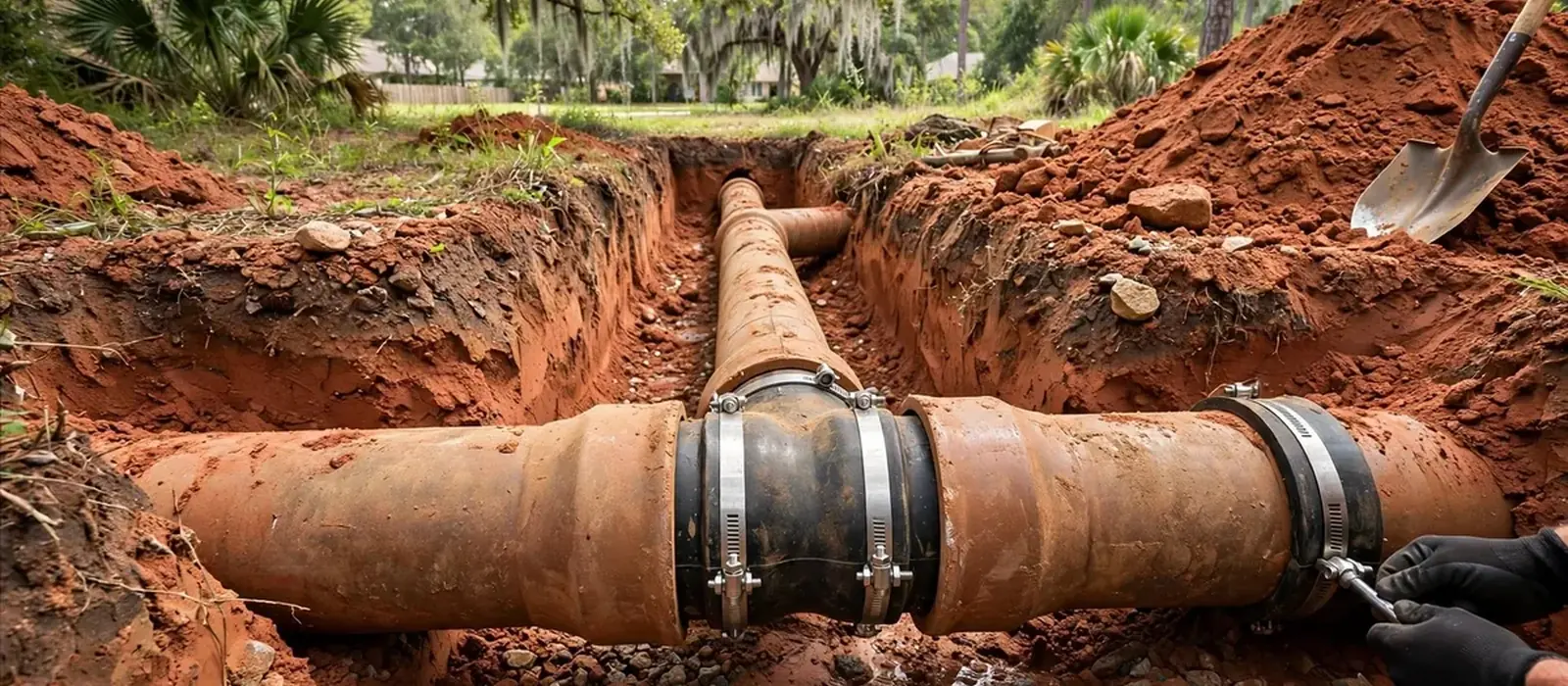
Sewer line repair means fixing the pipe that carries waste from your house to the public sewer, either by replacing the damaged section or by lining it from the inside. That pipe is the lateral. The city main is the larger public pipe it connects to, usually under the street.
Ocoee's sewer use manual defines the lateral as the service line from the public sewer to a point five feet outside the building wall. It does not say plainly who repairs which stretch. Before anyone digs, call City of Ocoee Utilities at 407-905-3100 and ask which side of the connection your problem is on.
Signs the problem is the line and not one drain
Several fixtures act up at once. A toilet gurgles when the washer drains. The lowest tub or floor drain backs up first. Clogs come back within weeks of being cleared, which tells us the blockage keeps re-forming from a damaged section.
Outside, a soggy strip of lawn, a sunken line in the grass or a sewer smell near the cleanout can also mark a broken pipe. A camera inspection of the sewer line confirms it before anyone digs.
Sewage in the house right now?
Stop the water, keep people out of the wet area and call. Dispatch is open day and night.
Dig and replace, or fix it without a trench
There are three common ways to fix a failed lateral. The right one depends on what the camera shows, not on what is cheapest to advertise.
Open trench replacement
- Works on any failure: collapsed pipe, offset joints, a low spot holding water.
- Gives you all-new pipe set to a checked slope.
- Tears up whatever sits on top: lawn, walkway, driveway or slab.
- Needs a utility locate before digging and usually a permit.
Trenchless lining or pipe bursting
- Lining coats the inside of a cleaned pipe with resin. It needs a pipe that is still round and in line.
- Lining cannot fix a belly where water pools, or a pipe that has shifted apart.
- Pipe bursting pulls new pipe along the old path and needs a pit at each end.
- Both mean far less digging, but neither suits every pipe.
A technician decides after cleaning the line and running the camera. If roots have only entered one joint, a short spot repair may be enough. If the pipe is crushed along most of its run, lining is off the table and we will say so. Ask to see the footage that supports whichever method is proposed.
What fails, what the camera shows, and the usual fix
Most sewer line failures leave a recognizable picture on camera. This is how we read them.
| Failure cause | What the camera shows | Usual fix |
|---|---|---|
| Roots in the joints | Fine roots poking in at pipe seams, thickening into a ragged mass | Cut the roots, then reline or replace the joint if the seam is open |
| Grease buildup | A hard, rough coating narrowing the pipe, often with no damage underneath | Cleaning, such as sewer line cleaning, with no repair if the pipe is sound |
| Cracked or broken pipe | A split, a missing piece or soil visible through the wall | Spot repair, lining or replacement of that section |
| Offset joint or belly | Pipe ends that no longer line up, or a pool of standing water at a low spot | Dig and re-lay that section, because lining will not fix the slope |
| Collapsed pipe | A crushed shape that stops the camera from passing | Open trench replacement |
A camera shows what is inside the pipe. A locator on the surface then marks how deep the problem is and where it sits.
What drives the cost of a sewer line repair
Sewer work ranges from a short spot repair to a full lateral replacement, so there is no honest single number. These are the factors that move the price.
Homeowners policies usually respond to sudden and accidental damage, and often not to wear, slow root damage or the repair of the pipe itself. Some policies add a separate sewer or water-backup endorsement. Ask your insurer before work starts, and keep your photos and the written findings.
What Ocoee homeowners should know about their sewer line
Ocoee runs its own wastewater utility, and a few local facts change how a repair is planned.
A city system with a private lateral
City of Ocoee Utilities provides wastewater service. We could not find a published rule on who owns the lateral, so ask the utility which side your failure is on. That answer decides whether you hire a plumber or file a report.
Grease is the city's own warning
The City says grease poured down drains can clog pipes and cause sewer backups. A grease-coated pipe needs cleaning, not a dig, so the camera check comes before any repair quote.
Roots and soil
UF/IFAS notes that roots grow well wherever moisture and nutrients are available, and a leaking joint supplies both. Many Florida upland soils are sandy and drain fast, but we do not assume yours. The camera shows what is actually inside the pipe.
Lining has a state code rule
The Florida Building Commission's declaratory statement DS 2024-044 says lining must follow ASTM F1216 or F1743. Lining only part of a pipe needs building official approval. Ask any lining contractor which standard applies to your job.
Sunken ground over the pipe
The Florida Geological Survey lists broken sewer and drain pipes among causes of ground sinking that can look like a sinkhole. Keep water out of any hole and have the line checked before anyone concludes it is natural.
Plumbing work in Ocoee needs a permit through permits.ocoee.org, and the Building Division is at 407-905-3104. We found no sewer-specific rule, so confirm your scope with them. Our dispatch also reaches nearby Apopka, where the same repair options apply.
How a sewer repair job runs, start to finish
Here is the usual order of work once the line is confirmed as the problem. After-hours calls start with stopping the backup, and same-day appointments are offered when available for the repair visit.
Clear the line and find the failure
The technician clears the blockage so the camera can pass, then records where the pipe breaks, roots in or sags. We cover how that works in our sewer camera inspection guide.
Pick the method and set the price
You see the findings, hear why one method fits and the others do not, and get a clear price before work starts.
Locate, permit and repair
Utility lines get marked through Sunshine 811, which Florida law requires two full business days before digging. The permit is pulled, then the repair is done.
Test and restore
Water is run through the new section to confirm it flows. Ask what is included for a final camera pass, and what surface restoration is in the price.
Sewer repair questions Ocoee homeowners ask
Yes. Ocoee Express Plumbing dispatches licensed plumbers day and night, and an after-hours backup is treated as an emergency call. Same-day appointments are offered when available, and the first visit is usually about stopping the backup and finding the cause.
A full repair may be scheduled separately, because digging needs a utility locate and a permit.
Call a plumber first if sewage is inside your house, since the line from your building to the street is often the problem. If the plumber finds the blockage in the public main, report it to the City through ocoee.org/737 or 407-905-3100.
The City's Utilities page lists an after-hours emergency number, 407-428-5766, but it does not say that line takes sewer overflow reports, so ask when you call. If your address is served by Orange County Utilities, the county 24/7 dispatch line is 407-836-2777. That is a county number, not a City of Ocoee number.
One slow drain usually means a branch clog, which drain cleaning handles. When several fixtures back up together, or the lowest drain overflows first, the blockage is farther down the line.
We do not diagnose that over the phone. A camera run settles it.
Sometimes. Lining works when the pipe is still round and lined up. It does not fix a collapsed pipe or a low spot holding water, and those need a trench.
The camera footage decides which applies.
The Florida Building Commission's staff analysis for DS 2024-044 says lining must follow ASTM F1216 or F1743. It found partial lining, sometimes called gapping, is not specifically covered. That makes it a proposed alternative that needs local building official approval.
The City lists plumbing among work that needs a building permit, applied for at permits.ocoee.org. We found no rule written only for sewer repair or lining, so call the Building Division at 407-905-3104 and describe the job.
Tenants should tell the landlord or property manager right away, because the owner approves the repair. When sewage is entering a unit, say so plainly when you call. Stopping water use is the urgent part while the owner arranges service.