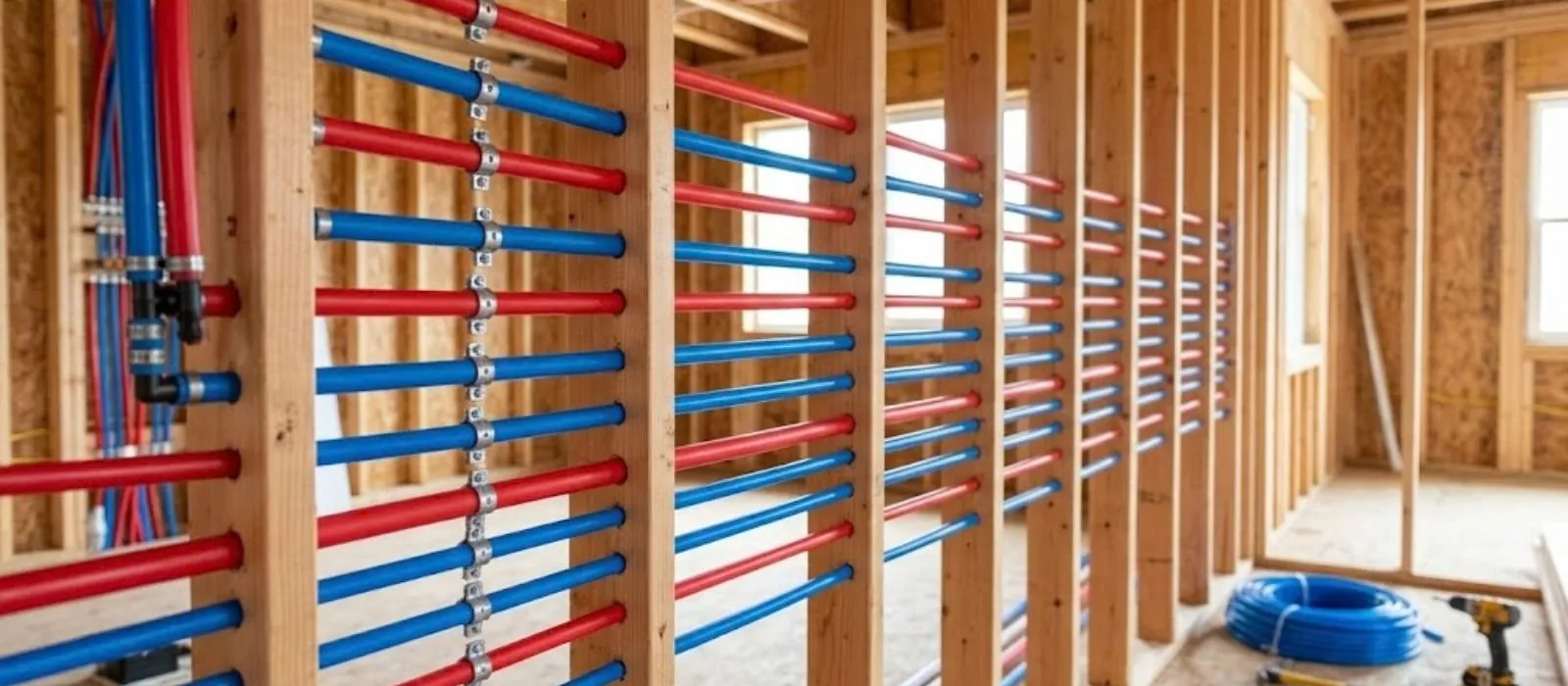
Pipe and fitting types sorted by job
A fitting is any piece that joins, turns, splits or ends a pipe, such as an elbow, tee, coupling, union, adapter or cap. The fitting has to suit the pipe it joins. The table below follows the 2023 Florida Building Code, Plumbing (8th Edition) tables we reviewed.
| Job | Pipe materials on the code list | How fittings usually connect |
|---|---|---|
| Hot and cold water inside the house | Copper (Types K, L, M), CPVC, PEX and PEX composites, polypropylene, galvanized steel, stainless, others | Solder or brazing for copper, solvent cement for CPVC, crimp or clamp for PEX |
| Water service from the main to the house, underground | The distribution materials plus ABS, polyethylene and PVC | Matched to the pipe, so a PVC service line takes PVC fittings |
| Drain and vent above ground | ABS, cast iron, copper DWV, galvanized steel, PVC, and a few others | Solvent cement for ABS and PVC, couplings for cast iron |
| Drain below ground | ABS, cast iron, copper, polyethylene, PVC and others | Same material fittings, set on a firm bed |
Plain PVC appears for water service and for drains, but not on the list for hot and cold distribution inside a house.
Common fitting shapes and what each one does
The same few shapes appear in every material. Knowing the names helps you read a parts list or a plumber's estimate.
Elbow
Turns the pipe 90 or 45 degrees. Every turn in a rigid line costs a little water pressure and adds a joint.
Tee
Splits one line into two, such as a branch to a sink off a main run.
Coupling and union
A coupling joins two pieces permanently. A union can be unscrewed, which makes it useful beside a water heater or pump.
Adapter
Connects one material or thread type to another, such as pipe to a faucet supply.
Cap and plug
Seals the end of a line. A proper cap is the right fix for an abandoned branch, not a piece of tape.
Not sure what is in your walls?
Call and describe the pipe you see near the water heater, and a dispatcher will book a licensed plumber.
The rule that catches DIY repairs
The code requires distribution pipe to meet NSF 61 and carry a pressure rating of at least 100 psi at 180 degrees Fahrenheit. Fittings must be approved for use with the pipe material actually installed. A fitting that fits the thread or socket but is not approved for that pipe is still the wrong fitting.
Plain white PVC from the hardware aisle is the classic mistake. It is fine for many drains, but it is not on the code list for hot and cold supply inside the house.
If you want to replace a section and are unsure what is in your walls, that is a good time to book a licensed plumber. Our plumbing installation visits include matching new work to existing pipe.
Rigid pipe versus flexible pipe for supply lines
Copper and CPVC are rigid and need a fitting at every turn. PEX is flexible and can bend around corners, which changes how many joints end up inside walls.
Copper and CPVC (rigid)
- Many elbows and couplings, each one a joint that has to be cut and joined cleanly
- Copper is joined by solder or brazing. CPVC is joined by solvent cement
- A badly made cement joint may hold at first and leak later under pressure
- Both are on the code's distribution list
PEX (flexible)
- Long runs between fittings, so fewer hidden joints
- Connects with crimp, clamp or expansion fittings made for PEX
- Needs the right tool and fitting match for the brand and size
- On the code's distribution list, along with PEX composite types
None of these is the winner in every house. The better choice depends on how much wall access you have, what is already installed, and what the building division accepts for your permit.
Old pipe: polybutylene and galvanized steel
Polybutylene, often gray plastic stamped PB2110, was made between 1978 and mid-1995, according to InterNACHI. It is not on the code's list for new water distribution piping. InterNACHI also notes that no regulation requires you to replace it.
The City of Ocoee's housing element, based on 1990 and 2000 Census figures, shows a large share of homes built in the 1980s and 1990s. That does not mean your house has it. It does mean a house from those years is worth checking for gray plastic near the water heater or main shutoff.
Replacing a failing run is a re-pipe, and our repiping visits start with identifying what is in the walls.
What Ocoee records about pipes and permits
The City of Ocoee reports that its 2024 lead service line inventory found no lead or galvanized service lines requiring replacement. That covers the city-side service lines, not the pipes inside your house, so an older home can still have galvanized steel inside the walls.
Ocoee's 2025 residential plumbing fee sheet lists a flat permit category for residential re-pipes. Permit rules vary by project, so ask the Building Division at 407.905.3104 before you start. The code edition may change on December 31, 2026, so check which one applies when your permit is pulled.
Source type: City of Ocoee water quality report and residential plumbing fee sheet
Where we can help nearby
Ocoee Express Plumbing dispatches licensed plumbers to Ocoee and to neighboring Windermere and Winter Garden. We give a clear price before work starts, and we explain which pipe and fittings we recommend and why.
Pipe material questions for Ocoee homeowners
Not under the 2023 Florida Building Code, Plumbing tables we reviewed. CPVC, copper, PEX and several other materials are on the distribution list, but plain PVC is not.
PVC is allowed for underground water service and for drains.
The Florida Building Code requires a permit to alter or replace a plumbing system, and Ocoee's fee sheet has a flat category for residential re-pipes. Call the Building Division at 407.905.3104 to confirm the steps for your project.
Look near the water heater and main shutoff. Copper is reddish brown or green with age. CPVC is rigid and cream or tan. PEX is flexible and often red, blue or white. Gray flexible plastic may be polybutylene.
A plumber can confirm what you see.
Only with a fitting approved for both materials. The code requires fittings to be approved for the pipe installed, so a transition fitting made for that pair is the safe route.
Taping or gluing mismatched parts is a common cause of leaks.
It is on the code's distribution list. It tends to be an older material that many owners replace when flow drops or rust appears, and a plumber can look at the pipe to see if that makes sense for your house.