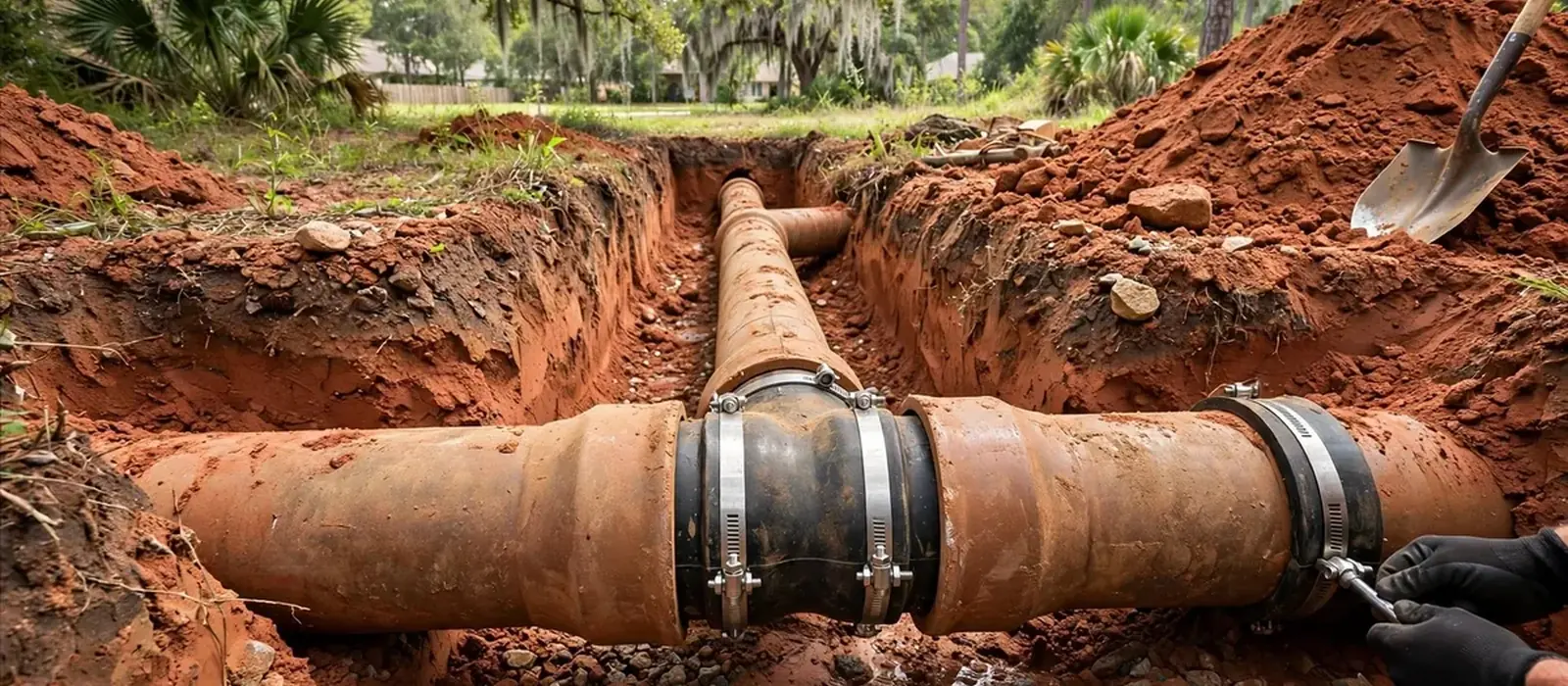
What epoxy lining does and where it stops
Epoxy lining, often called cured-in-place pipe or CIPP, puts a new resin-coated tube inside the old sewer pipe. The tube is pressed against the wall and hardened, so the old pipe becomes a host for a new inner pipe. The ICC's code notes describe it as a resin-saturated felt tube inverted into a cleaned pipe and cured by heat or UV light.
The big benefit is that the yard, driveway and landscaping mostly stay in place. The big limit is that a liner follows the shape of the pipe it goes into. If the old pipe has dropped, shifted or collapsed, the liner will carry that fault with it. A camera inspection decides which case you have, so sewer inspection comes before any lining quote.
Lining versus digging up the line
Both fix a broken sewer line. They suit different damage, and neither is better in every case. If the problem is only a clog, sewer line cleaning comes first.
Epoxy or CIPP lining
- Works through small access points, so less of the yard and hard surfaces are opened.
- Suits cracks, joint gaps, root entry and rough pipe walls in a line that still runs straight.
- Needs a clean pipe first, so cutting out roots and debris is part of the job.
- Leaves the old pipe in place, so a bad slope or a collapsed section is not corrected.
Open-trench [[sewer-line-repair|sewer line repair]]
- Replaces the failed pipe with new pipe, which can fix a sag, an offset or a collapse.
- Opens the ground, so it affects lawns, driveways and anything above the line.
- Calls for a Sunshine 811 locate before digging, which adds time.
- May be the only answer when the old pipe has lost its shape.
We cannot say which will cost less for your home without seeing the line, and we do not quote costs here. A clear price comes before work starts.
Camera shows a cracked or root-filled line?
Ocoee Express Plumbing can walk you through whether lining or replacement suits what the camera found.
When lining fits and when it does not
This table reflects how the trade generally describes the choice. We found no Florida government source that lists failure cases for lining, so ask any contractor to show you the camera footage that supports the recommendation.
| Condition seen on camera | Lining a good fit? | Why |
|---|---|---|
| Hairline cracks or open joints in straight pipe | Often yes | The liner seals the wall without moving the pipe |
| Roots entering at joints | Often yes, after the roots are cut out | A sealed liner closes the joints roots use to enter |
| Belly or sag holding standing water | Usually no | The liner copies the low spot, so waste still pools |
| Collapsed or badly offset section | Usually no | The tube cannot pass or will not seal against a gap |
| Heavy scale or damage from an earlier repair | Case by case | The pipe must be cleaned and the surface sound enough to bond |
A sagging line often shows up first as repeat clogs, so a camera look should come before any decision to line.
Signs a sewer line may need more than cleaning
Lining is a repair, not a cleaning, so it only enters the picture once cleaning has stopped working. Repeat clogs in the same month, several drains backing up together and a sewer smell near the cleanout all point at the pipe itself. Wet or sunken ground along the line points the same way.
Florida's Geological Survey adds a local wrinkle. It lists collapsed or broken sewer and drain pipes among the causes of ground sinking that can mimic sinkhole activity. If the ground near your sewer line is dropping, have a licensed plumber camera the pipe before you assume the cause is geology.
What Florida code and Ocoee say about lining
A staff analysis for Florida Building Commission declaratory statement DS 2024-044 says the 2023 Florida Building Code, Plumbing section 718.1 and the residential section P3012.1 call for CIPP rehabilitation to follow ASTM F1216 or F1743. Staff also found that partial lining, often called gapping, and hybrid lining are not covered by those provisions. They are treated as a proposed alternative that needs approval from the local building official.
In plain terms, ask the contractor which standard the liner follows and whether the job is a full or partial lining. A full-length liner built to one of the named ASTM standards sits on firmer ground than a partial one that needs special approval.
The City of Ocoee says plumbing work needs a building permit, applied for at permits.ocoee.org or at the Building Division on the first floor of City Hall. The staff analysis did not discuss permits, and we found no Ocoee rule written specifically for lining a private sewer line. Call the Building Division at 407-905-3104 before the work is scheduled.
One caution on sources. The ICC code notes mentioned above explain the International Plumbing Code, not the Florida code, so treat them as background on how lining works only.
Source type: Florida Building Commission declaratory statement DS 2024-044 staff analysis, City of Ocoee Building Division and ICC CodeNotes
Questions to ask before you agree to a liner
Use these to test any proposal, ours or anyone else's.
- Can I see the camera footage of the whole line, including the problem spot?
- Is this a full-length liner or a partial one, and which ASTM standard does it follow?
- Who pulls the permit, and has the City of Ocoee Building Division confirmed it is needed?
- What happens to the cleanout and the connection at the street side?
- Will a second camera run after curing show the finished liner?
Licensed plumbers dispatched by Ocoee Express Plumbing can explain these points for homes in Ocoee, Apopka and Pine Hills once the camera has been run.
Sewer lining questions for Ocoee homeowners
The staff analysis for DS 2024-044 found that partial lining, also called gapping, is not addressed by the plumbing code section or the ASTM standards. It is treated as an alternative that needs local building official approval. Ask the Building Division before agreeing to a partial liner.
Ocoee says plumbing work needs a building permit. We found no rule written only for lining, so we cannot say how the city classes it. Call the Building Division at 407-905-3104 and ask.
Often the roots are cut out first and the pipe is cleaned before the liner goes in. Lining is meant to close the joints roots use to get in, and a camera check afterward shows whether it did.
We did not find a Florida source that gives a service life, and we will not invent one. Ask the contractor what product is used and what standard it meets.